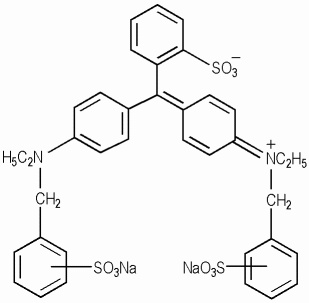
Characteristics
- INCI
- Ci 42090
- Ru.
- Blue 1
- CAS
-
3844-45-9
This is the substance number in the Chemical Abstracts Service registry. The CAS number uniquely identifies a substance regardless of language, trade name, or synonyms.
- EC
-
223-339-8
This is the substance number in the European chemical identification system (EC number), used in European regulatory databases including ECHA/CosIng.
- IUPAC
- Dihydrogen (Ethyl)[4-[4-[Ethyl(3-Sulphonatobenzyl)]Amino]-2'-Sulphonatobenzhydrylidene]Cyclohexa-2,5-Dien-1-Ylidene](3-Sulphonatobenzyl)Ammonium, Disodium Salt
- Functions
- cosmetic colorant
- EU Restr.
-
IV/63
EU regulatory status: restricted use. The ingredient is permitted in EU cosmetics but its use and labelling are regulated.
More detail →
Who it's for
Description
If a product looks like it was plucked straight out of a swimming pool or a candy shop, there’s a decent chance this little dye is doing the heavy lifting. CI 42090, also called Blue 1 or Brilliant Blue FCF, is a synthetic color additive used to give formulas a bright blue shade, and sometimes to help create green tones when it’s mixed with a yellow dye. It shows up in lots of rinse-off products like shampoos, body washes, and cleansers, but also in makeup and other color cosmetics where the final look matters just as much as the formula itself.
Here’s the important bit: CI 42090 does not do anything active for your skin or hair. It doesn’t hydrate, exfoliate, calm, repair, or protect. Its job is purely aesthetic, which may sound superficial, but in cosmetics that’s a perfectly valid gig. A blue cleanser can feel fresher to some people, a tinted shampoo can look more polished, and a lip or eye product may need a precise color payoff that only a dye like this can deliver. It’s also approved for use in many countries, including the US and EU, where color additives are regulated more tightly than your average ingredient list drama.
As for safety, CI 42090 is generally considered safe when used at permitted concentrations. Most people tolerate it well, but, as with any colorant, there are occasional reports of sensitivity or irritation, especially in leave-on products or formulas used around the eyes and lips. That doesn’t mean the dye is inherently sinister; it mostly means your skin is telling you it prefers a simpler life. If you know you react to strongly colored cosmetics, patch testing is a sensible move. In other words, this ingredient is mostly here to make your product look pretty, not to audition as a skincare hero.
More detail
CI 42090, also known as Blue 1 or Brilliant Blue FCF, is a synthetic colorant used to give products a vivid blue shade. You’ll find it in everything from cleansers, shampoos, conditioners, and body washes to makeup, bath products, and even some foods. It doesn’t treat skin or hair or change their condition; its job is purely cosmetic, helping a formula look more appealing, more recognizable, or more on-brand. In blends, it can also be mixed with yellow dyes such as Tartrazine to create green tones.
For skincare and haircare users, CI 42090 is mainly about aesthetics. It can make a shampoo look fresh and “clean,” give a gel cleanser a bright jewel tone, or add color to a lip product or eye product. People who enjoy colorful, playful formulas may appreciate it, especially in rinse-off products where the dye is less likely to linger. Because it is a color additive rather than an active ingredient, it offers no moisturizing, soothing, or strengthening benefits on its own.
Caveat: as with any synthetic dye, some people prefer to avoid it due to personal preference, sensitivity concerns, or a desire for simpler ingredient lists. If you know you react to colored cosmetics or fragranced products, it’s worth checking the full formula and patch testing new products when possible. Otherwise, CI 42090 is generally just there to make the product look blue.
Products with Ci 42090 (7 030 total)
Most often found in Dove products (78 items)


