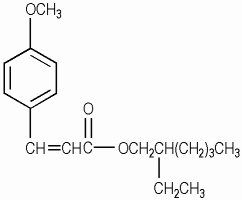
Characteristics
- INCI
- Ethylhexyl Methoxycinnamate
- Ru.
- Octinoxate, Octyl Methoxycinnamate
- CAS
-
5466-77-3
This is the substance number in the Chemical Abstracts Service registry. The CAS number uniquely identifies a substance regardless of language, trade name, or synonyms.
- EC
-
226-775-7
This is the substance number in the European chemical identification system (EC number), used in European regulatory databases including ECHA/CosIng.
- IUPAC
- 2-Ethylhexyl 4-Methoxycinnamate
- Functions
- uv absorber, uv filter
- Irritancy
-
0 / 5
Irritation potential: 0–5, where 5 is the highest irritation rating for the ingredient.
More detail → - Comedogen.
-
0 / 5
Comedogenicity index: 0–5. A non-comedogenic ingredient (0–1) is unlikely to cause cosmetic acne.
More detail → - EU Restr.
-
VI/12
EU regulatory status: restricted use. The ingredient is permitted in EU cosmetics but its use and labelling are regulated.
More detail →
Who it's for
Description
A clear, oil-soluble, "cosmetically-elegant" liquid that is the most commonly used chemical sunscreen.It absorbs UVB radiation (at wavelengths: 280-320 nm) with a peak protection at 310nm.
It only protects against UVB and not UVA rays(the 320-400 nm range) – so always choose products that contain other sunscreens too. It is not very stableeither, when exposed to sunlight, it kind of breaks down and loses its effectiveness (not instantly, but over time - it loses 10% of its SPF protection ability within 35 mins). To make it more stable it can be - and should be - combined with other sunscreen agents to give stable and broad-spectrum protection (the new generation sunscreen agent, Tinosorb S is a particularly good one for that).
Regarding safety, there are alsosome concerns around Octinoxate. In vitro (made in the lab not on real people) and animal studies have shown that it may produce hormonal (estrogen-like) effects. Do not panic,the studies were not conducted under real life conditions on real human people, so it is probably over-cautious to avoid Octinoxate altogether. However, if you are pregnant or a small child (under 2 yrs. old), choose a physical (zinc oxide/titanium dioxide) or new-generation Tinosorb based sunscreen, just to be on the super-safe side. :)
Overall, Ethylhexyl Methoxycinnamate is an old-school chemical sunscreen agent. There are plenty of better options for sun protection today, but it is considered "safe as used" (and sunscreens are pretty well regulated) and it is available worldwide (can be used up to 10% in the EU and up to 7.5% in the US).
Frequently Asked Questions about Ethylhexyl Methoxycinnamate
What is ethylhexyl methoxycinnamate and what is it used for?
Is ethylhexyl methoxycinnamate safe to use on skin?
What are the benefits of ethylhexyl methoxycinnamate in sunscreen?
Can ethylhexyl methoxycinnamate cause side effects?
Is ethylhexyl methoxycinnamate safe during pregnancy?
Evidence & Research on Ethylhexyl Methoxycinnamate
-
1
Couteau, C., et al. "Study of the efficacy of 18 sun filters authorized in European Union tested in vitro." Die Pharmazie-An International Journal of Pharmaceutical Sciences 62.6 (2007): 449-452.Find in PubMed
-
2
Couteau, Céline, et al. "Study of the photostability of 18 sunscreens in creams by measuring the SPF in vitro." Journal of pharmaceutical and biomedical analysis 44.1 (2007): 270-273.Find in PubMed
-
3
Chatelain, Eric, and Bernard Gabard. "Photostabilization of Butyl methoxydibenzoylmethane (Avobenzone) and Ethylhexyl methoxycinnamate by Bis-ethylhexyloxyphenol methoxyphenyl triazine (Tinosorb S), a New UV Broadband Filter." Photochemistry and Photobiol
-
4
Janjua, Nadeem Rezaq, et al. "Systemic absorption of the sunscreens benzophenone-3, octyl-methoxycinnamate, and 3-(4-methyl-benzylidene) camphor after whole-body topical application and reproductive hormone levels in humans." Journal of Investigative Derm
-
5
Schlumpf, Margret, et al. "In vitro and in vivo estrogenicity of UV screens." Environmental health perspectives 109.3 (2001): 239.Find in PubMed
Products with Ethylhexyl Methoxycinnamate (9 047 total)
Most often found in Biore products (77 items)


