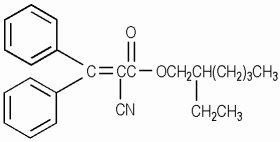
Characteristics
- INCI
- Octocrylene
- CAS
-
6197-30-4
This is the substance number in the Chemical Abstracts Service registry. The CAS number uniquely identifies a substance regardless of language, trade name, or synonyms.
- EC
-
228-250-8
This is the substance number in the European chemical identification system (EC number), used in European regulatory databases including ECHA/CosIng.
- IUPAC
- 2-Cyano-3,3-Diphenyl Acrylic Acid 2-Ethylhexyl Ester
- Functions
- uv absorber, uv filter
- EU Restr.
-
VI/10
EU regulatory status: restricted use. The ingredient is permitted in EU cosmetics but its use and labelling are regulated.
More detail →
Who it's for
Description
An oil-soluble chemical sunscreen agent that protects skin in the UVB and somewhat in the UVA II range with a peak absorption of 304 nm. Its protection is not strong enough on its own but it is quite photostable (loses 10% of SPF protection in 95 mins) and is often used to stabilize other photo-unstable UV-filters, for example, Avobenzone. It is also often used to improve the water resistance of the products.
Octocrylene's safety profile is generally quite good, though a review study in Contact Dermatitis reports an "increasing number of patients with photo contact allergy to octocrylene." Mainly adults with ketoprofen-sensitivity and children with sensitive skin are affected, so if you have a small kid, it is probably better to use octocrylene-free sunscreens.
Frequently Asked Questions about Octocrylene
What does octocrylene do in sunscreen?
Is octocrylene safe for skin?
Can octocrylene cause an allergic reaction?
Is octocrylene bad for your skin?
Is octocrylene the same as octinoxate?
Evidence & Research on Octocrylene
-
1
Couteau, C., et al. "Study of the efficacy of 18 sun filters authorized in European Union tested in vitro." Die Pharmazie-An International Journal of Pharmaceutical Sciences 62.6 (2007): 449-452.Find in PubMed
-
2
Couteau, Céline, et al. "Study of the photostability of 18 sunscreens in creams by measuring the SPF in vitro." Journal of pharmaceutical and biomedical analysis 44.1 (2007): 270-273.Find in PubMed
-
3
Scalia, Santo, and Matteo Mezzena. "Incorporation in lipid microparticles of the UVA filter, butyl methoxydibenzoylmethane combined with the UVB filter, octocrylene: effect on photostability." AAPS PharmSciTech 10.2 (2009): 384-390.Find in PubMed
-
4
de Groot, Anton C., and David W. Roberts. "Contact and photocontact allergy to octocrylene: a review." Contact dermatitis 70.4 (2014): 193-204.Find in PubMed
Products with Octocrylene (5 777 total)
Most often found in Nivea products (124 items)


