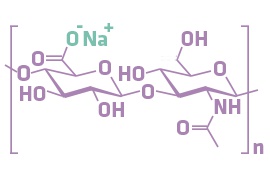
Characteristics
- INCI
- Sodium Hyaluronate
- CAS
-
9067-32-7
This is the substance number in the Chemical Abstracts Service registry. The CAS number uniquely identifies a substance regardless of language, trade name, or synonyms.
- IUPAC
- Hyaluronic Acid, Sodium, Salt
- Functions
- humectant, skin conditioning
- Irritancy
-
0 / 5
Irritation potential: 0–5, where 5 is the highest irritation rating for the ingredient.
More detail → - Comedogen.
-
0 / 5
Comedogenicity index: 0–5. A non-comedogenic ingredient (0–1) is unlikely to cause cosmetic acne.
More detail →
Who it's for
Description
If your skin ever feels like it’s auditioning for the role of “thirsty desert,” this ingredient is one of the classic fixes. Sodium hyaluronate is the salt form of hyaluronic acid, a molecule your skin naturally uses to keep water where it belongs. Its party trick is simple but impressive: it binds a lot of water, which helps skin look more cushioned, smoother, and less cranky. In skincare, that usually translates into the kind of plumper look people are after when they ask whether it’s good for skin or face. Short answer: yes, very often, especially if dryness is making fine lines look more obvious.
So how does sodium hyaluronate work? Mostly by acting as a humectant, meaning it pulls and holds water in the upper layers of your skin. That’s why you’ll find it in many serums, moisturizers, and “best” hydrating formulas. In a 4-week study on a topical hyaluronic acid product, participants saw improvements in skin hydration and wrinkle appearance, and sodium hyaluronate does the same job on ingredient lists all over the place. It’s not a miracle wrinkle eraser, but the primary benefit is very real: better hydration, better bounce, and often a nicer-looking skin surface. The best sodium hyaluronate serum is usually the one paired with good moisturizers like glycerin, ceramides, or squalane, because water-loving ingredients work best when they’re not left stranded on their own.
You’ll also see sodium hyaluronate eye drops and ophthalmic solutions used for dry eyes, where the ingredient helps lubricate and soothe the eye surface. In studies, hyaluronic acid-based drops have been shown to improve dry eye symptoms and tear film stability, with concentrations like 0.2% commonly used in eye-drop formulas. If you’re wondering how to use sodium hyaluronate eye drops or an ophthalmic solution, follow the product directions and don’t touch the tip to your eye, because nobody needs an extra infection plot twist. In medicine, sodium hyaluronate also has a long history in osteoarthritis injections, where the main benefit is joint lubrication and cushioning; some people get modest pain relief, though results can vary and it’s not a magic alternative to other treatments. Whether you’re looking for the best sodium hyaluronate powder, supplement, eye drops, or skin product, the “best brand” depends less on the name on the box and more on purity, concentration, and whether the formula actually suits your needs.
As for how to use sodium hyaluronate in skincare, apply it to slightly damp skin and seal it in with a moisturizer, otherwise it can feel a bit underwhelming in dry air. And if you’re hunting for a sodium hyaluronate alternative, other humectants like glycerin or panthenol can do a respectable job too. The advantages of sodium hyaluronate are pretty straightforward: it’s well tolerated, versatile, and genuinely useful for dehydration. The health benefits of sodium hyaluronate are strongest in hydration-related uses, while the skincare benefits are all about making your skin feel less tight and look a bit more fresh-faced. Not bad for a molecule with such an unglamorous name.
More detail
It’s the - sodium form - cousin of the famous NMF, hyaluronic acid (HA). If HA does not tell you anything we have a super detailed, geeky explanation about it here. The TL; DR version of HA is that it's a huge polymer (big molecule from repeated subunits) found in the skin that acts as a spongehelping the skin to hold onto water, being plump and elastic. HA is famous for its crazy water holding capacity as it can bind up to 1000 times its own weight in water.
As far as skincare goes, sodium hyaluronate and hyaluronic acid are pretty much the same and the two names are used interchangeably. As cosmetic chemist kindofstephen writes on reddit "sodium hyaluronate disassociates into hyaluronic acid molecule and a sodium atom in solution".
In spite of this, if you search for "hyaluronic acid vs sodium hyaluronate" you will find on multiple places that sodium hyaluronate is smaller and can penetrate the skin better. Chemically, this is definitely not true, as the two forms are almost the same, both are polymers and the subunits can be repeated in both forms as much as you like. (We also checked Prospector for sodium hyaluronate versions actually used in cosmetic products and found that the most common molecular weight was 1.5-1.8 million Da that absolutely counts as high molecular weight).
What seems to be a true difference, though, is that the salt form is more stable, easier to formulate and cheaper so it pops up more often on the ingredient lists.
If you wanna become a real HA-and-the-skin expert you can read way more about the topic at hyaluronic acid (including penetration-questions, differences between high and low molecular weight versions and a bunch of references to scientific literature).
Frequently Asked Questions about Sodium Hyaluronate
What does sodium hyaluronate do in skincare?
Is sodium hyaluronate good for skin?
How does sodium hyaluronate work?
What are the benefits of sodium hyaluronate eye drops?
Can sodium hyaluronate be used in treatments for osteoarthritis?
Products with Sodium Hyaluronate (44 256 total)
Most often found in L'Oreal products (246 items)


