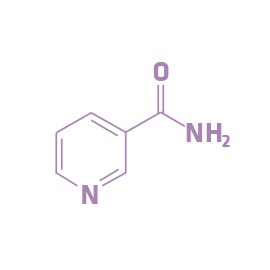
Characteristics
- INCI
- Niacinamide
- Ru.
- vitamin B3, nicotinamide
- CAS
-
98-92-0
This is the substance number in the Chemical Abstracts Service registry. The CAS number uniquely identifies a substance regardless of language, trade name, or synonyms.
- EC
-
202-713-4
This is the substance number in the European chemical identification system (EC number), used in European regulatory databases including ECHA/CosIng.
- IUPAC
- 3-Pyridinecarboxamide
- Functions
- smoothing
Who it's for
How Niacinamide Works
Niacinamide, or as us normal people call it vitamin B3, is a real skincare superstar that has had so many studies and has so many skin benefits that we have to warn you that this "geeky details" description will not be short.
Just as an intro a couple of thing about the stuff itself: it's a water-soluble vitamin that usually comes in white powder form. It is odorless and has a salty, bitter taste. It can be found in meat, fish, wheat and small amounts in vegetables. The version used in cosmetics is produced exclusively synthetically.
Let's look at all those skin benefits:
#1: Anti-aging, wrinkle-smoothing properties: With age, our skin tends to slow down in many ways. One of them is in producing important proteins, such as keratin, filaggrin, and involucrin, at a slower rate. Reduced amounts of these proteins results in poorer skin structure, reduced skin elasticity, and more wrinkles. Studies show that niacinamide can boost collagen production as well as the production of these three important proteins. That means improved skin structure and fewer wrinkles. FYI, anti-aging studies usually use 4-5% niacinamide daily for 8-12 weeks, so if you are after the anti-aging benefits try to choose a product that tells you the exact percentage of niacinamide it contains.
#2: Skin-lightening properties: Hyperpigmentation or brown spots are really stubborn and honestly it can be really hard to make them disappear just by topical products. What you can expect for them is to fade a little and niacinamide is a great ingredient to help with that. Studies show that 2-5% niacinamide used daily for 8 weeks results in significant lightening of hyperpigmentation. When combined with amino sugar, acetyl glucosamine the results are even better.
What's more, niacinamide as a skin lightener works in a way different to most others. It suppresses the transfer of melanosomes (little spheres carrying the melanin pigment) from melanocytes (skin cells producing the melanin) to keratinocytes (skin cells in the top layer of the skin) while most other skin lighteners block an enzyme called tyrosinase (that plays an important role in melanin production). So if you want to mount a multi-front attack on the brown spots you can combine a niacinamide treatment with tyrosinase inhibitors like vitamin C, arbutin or kojic acid.
#3:Barrier repair functions: the skin barrier is the outer layer of the skin that is amazingly important at keeping the skin hydrated and healthy. The stuff between the skin cells consists mainly of free fatty acids, cholesterol, and ceramides. The amount and structure of these determine how healthy the skin barrier is. What studies have shown is that 2% niacinamide can increase the synthesis of free fatty acids, cholesterol, and ceramides that result in healthier and stronger skin barrier, decreased trans-epidermal water loss and better hydrated skin.
#4: Anti-acne properties: though niacinamide does not count as one of the gold standard anti-acne ingredients, if you have problem skin it's totally worth a try. It has sebum regulating and anti-inflammatory properties and a study that used 4% niacinamide for 8 weeks to treat acne found that 82% of those treated showed some improvement. What's more, the results were slightly better than with a 1% clindamycin gel, an antibiotics often used to treat acne.
#5: Other notable things: if the above four things are not enough to convince you about niacinamide here are some more reasons! :) Studies show that vitamin B3 can help to speed up epidermal cell growth (that slows down with age), it can help with wound healing, it can smooth the structure of the skin and it has also antibacterial and photo protective properties. Plus, it might also be useful for rosacea and atopic dermatitis probably because of its anti-inflammatory property.
Well, that was long. Hope we could convince you that niacinamide is a skincare superstar and a must-tryforpretty mucheverybody. :)
Frequently Asked Questions about Niacinamide
What does niacinamide do for the skin?
Can niacinamide help with acne and oily skin?
How do you use niacinamide serum in a skincare routine?
Can niacinamide be used with hyaluronic acid, retinol, or salicylic acid?
Are niacinamide supplements good for the skin?
Niacinamide: Quick Facts
- A multi-functional skincare superstar with several proven benefits for the skin
- Great anti-aging, wrinkle smoothing ingredient used at 4-5% concentration
- Fades brown spots alone or in combination with amino sugar, acetyl glucosamine
- Increases ceramide synthesis that results in a stronger, healthier skin barrier and better skin hydration
- Can help to improve several skin conditions including acne, rosacea, and atopic dermatitis
Evidence & Research on Niacinamide
-
1
Walocko, Frances M., et al. "The role of nicotinamide in acne treatment." Dermatologic Therapy (2017).
-
2
Journal of Cosmetic Dermatology, Volume 13 (4) – Dec 1, 2014, A review of nicotinamide: treatment of skin diseases and potential side effects
-
3
Skin Pharmacol Physiol 2014;27:311-315, Niacinamide - Mechanisms of Action and Its Topical Use in DermatologyFind in PubMed
-
4
Journal of cosmetic dermatology, 2004 Apr;3(2):88-93., Nicotinic acid/niacinamide and the skin.Find in PubMed
-
5
Shalita, Alan R., et al. "Topical nicotinamide compared with clindamycin gel in the treatment of inelammatory acne vulgaris." International journal of dermatology 34.6 (1995): 434-437.Find in PubMed
-
6
Navarrete-Solís, Josefina, et al. "A double-blind, randomized clinical trial of niacinamide 4% versus hydroquinone 4% in the treatment of melasma." Dermatology research and practice 2011 (2011).
-
7
Tanno, O., et al. "Nicotinamide increases biosynthesis of ceramides as well as other stratum corneum lipids to improve the epidermal permeability barrier." British Journal of Dermatology 143.3 (2000): 524-531.Find in PubMed
Products with Niacinamide (30 295 total)
Most often found in Olay products (317 items)


