Characteristics
- INCI
- Retinyl Palmitate
- Ru.
- Form of Retinoids
- CAS
-
79-81-2
This is the substance number in the Chemical Abstracts Service registry. The CAS number uniquely identifies a substance regardless of language, trade name, or synonyms.
- EC
-
201-228-5
This is the substance number in the European chemical identification system (EC number), used in European regulatory databases including ECHA/CosIng.
- IUPAC
- Retinol, Hexadecanoate
- Functions
- skin conditioning
- Irritancy
-
1-3 / 5
Irritation potential: 0–5, where 5 is the highest irritation rating for the ingredient.
More detail → - Comedogen.
-
1-3 / 5
Comedogenicity index: 0–5. A non-comedogenic ingredient (0–1) is unlikely to cause cosmetic acne.
More detail →
Who it's for
Description
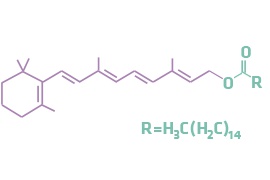
If retinoids are the skincare royal family, retinyl palmitate is the distant cousin who shows up looking polished but doesn’t always do much at the party. It’s vitamin A joined to palmitic acid, which makes it one of the gentlest, most stable forms of vitamin A used in cosmetics. That stability is one reason you’ll see it in all sorts of retinyl palmitate products, from moisturizers to eye creams, and even in some supplement discussions under the name vitamin A palmitate.
So how does retinyl palmitate work? In theory, your skin has to convert it step by step into retinoic acid, the active form that actually talks to skin cells. The catch is that this conversion is relatively inefficient. That’s why, compared with retinol, it tends to be a much weaker player. In practice, the benefits of retinyl palmitate on skin are usually modest at best: think a little antioxidant support and maybe some very mild anti-aging help, not the kind of results you’d expect from prescription retinoids. If you’re wondering how effective is retinyl palmitate, the honest answer is: not very impressive. It’s not useless, but it’s also not the superstar some marketing claims would like you to believe.
There’s also the famous retinyl palmitate vs retinol comparison. Retinol is closer to the active form, so it generally has more evidence behind it for improving fine lines and uneven texture. Retinyl palmitate is milder, but that doesn’t automatically make it better; it mostly means it may be less irritating, and also less effective. A few older studies have hinted at some photoprotective or antioxidant effects, while others raised concerns about potential instability in UV light. Because of that, many experts prefer using retinoids at night, and if you’re shopping for the best retinyl palmitate cream or the best retinyl palmitate products, the safest bet is usually to treat it as a supporting ingredient rather than the main event.
As for supplements, retinyl palmitate supplement and retinyl palmitate vitamin A basically point to the same thing: a preformed vitamin A source. That’s useful nutritionally, but it also means you should be careful with dosing, especially if you’re pregnant or breastfeeding, since too much preformed vitamin A can be a problem. If you’re asking how to take retinol palmitate or how to use retinyl palmitate, the answer depends on whether it’s oral or topical, and the label matters a lot. For topical use, follow the product instructions and, as a general rule, introduce it slowly. If you’re specifically looking for the benefits of vitamin A retinyl palmitate, they’re real but limited: mild support, not dramatic transformation. In other words, is retinyl palmitate good for skin? It can be, but if you want serious retinoid results, retinol or tretinoin usually earn the better seat at the table.
More detail
It's an ester form of vitamin A (retinol + palmitic acid) that belongs to the "retinoid family". The retinoid family is pretty much the royal family of skincare, with the king being the FDA-approved anti-aging ingredient tretinoin. Retinol is also a very famous member of the family, but it's like Prince George, two steps away from the throne. Retinyl palmitate will be then Prince Charlotte (George's little sister), quite far (3 steps) away from the throne.
By steps, we mean metabolic steps. Tretinoin, aka retinoic acid, is the active ingredient our skin cells can understand and retinyl palmitate (RP) has to be converted by our metabolic machinery to actually do something. The conversion is a 3 step one and looks like this:
retinyl palmitate --> retinol -- > retinaldehyde --> all-trans-retinoic acid
As we wrote in our lengthy retinol description the problem is that the conversion is not terribly effective. The evidence that RP is still an effective anti-aging ingredient is not very strong, in fact, it's weak. Dr. Leslie Baumann in her fantastic Cosmetic Dermatology book writes that RP is topically ineffective.
What's more, the anti-aging effectiveness is not the only questionable thing about RP. It also exibits questionable behaviour in the presence of UV light and was the center of a debate between the non-profit group, EWG (whose intentions are no doubt good, but its credibility is often questioned by scientists) and a group of scientists and dermatologists lead by Steven Q. Wang, MD, director of dermatologic surgery at Memorial-Sloan Kettering Cancer Centre.
Dr. Leslie Baumann wrote a great review of the debate and summarized the research available about retinyl palmitate here. It seems that there is a study showing RP being photo protective against UVB rays but there is also a study showing RP causing DNA damage and cytotoxicity in association with UVA.
We think that the truth lies somewhere in the middle, and we agree with Dr. Baumann's conclusion: "sufficient evidence to establish a causal link between RP and skin cancer has not been produced. Nor, I’m afraid, are there any good reasons to recommend the use of RP". We would add especially during the day!
Bottom line: If you wanna get serious about retinoids, RP is not your ingredient (retinol or tretinoin is!). However, if you use a product that you like and it also contains RP, there is no reason to throw it away. If possible use it at night, just to be on the safe side.
Frequently Asked Questions about Retinyl Palmitate
What is retinyl palmitate?
What does retinyl palmitate do for skin?
How is retinyl palmitate different from retinol?
Is retinyl palmitate safe to use in skincare?
How should retinyl palmitate products be used?
Evidence & Research on Retinyl Palmitate
-
1
The Journal of investigative dermatology, 2003 Nov;121(5):1163-7., Vitamin A exerts a photoprotective action in skin by absorbing ultraviolet B radiationFind in PubMed
-
2
Toxicology and industrial health, 2005 Sep;21(7-8):167-75., Photo-induced DNA damage and photocytotoxicity of retinyl palmitate and its photodecomposition products
-
3
Leslie Baumann, MD, Cosmetic Dermatology, 2nd edition, Retinoids, Chapter 30 - pages 256-262
Products with Retinyl Palmitate (5 570 total)
Most often found in Boots products (73 items)


