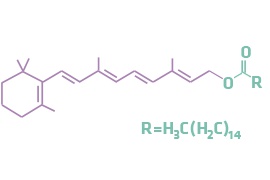
Características
- INCI
- Retinyl Palmitate
- Ru.
- Form of Retinoids
- CAS
-
79-81-2
Este es el número de sustancia en el registro del Chemical Abstracts Service. El número CAS identifica de forma exclusiva una sustancia independientemente del idioma, el nombre comercial o los sinónimos.
- EC
-
201-228-5
Este es el número de sustancia en el sistema europeo de identificación química (número CE), que se utiliza en las bases de datos regulatorias europeas, incluida la ECHA / CosIng.
- IUPAC
- Retinol, Hexadecanoate
- Funciones
- skin conditioning
- Irritabilidad
-
1-3 / 5
Potencial de irritación: 0-5, donde 5 es la calificación de irritación más alta para el ingrediente.
Más detalles → - Comedógeno.
-
1-3 / 5
Índice de comedogenicidad: 0-5. Es poco probable que un ingrediente no comedogénico (0-1) cause acné cosmético.
Más detalles →
Para quién
Descripción
Si los retinoides son la familia real del cuidado de la piel, palmitato de retinilo es el primo lejano que aparece luciendo pulido pero que no siempre hace mucho en la fiesta. Es vitamina A unida al ácido palmítico, lo que la convierte en una de las formas más suaves y estables de vitamina A utilizadas en cosméticos. Esa estabilidad es una de las razones por las que la verás en todo tipo de productos de palmitato de retinilo, desde humectantes hasta cremas para los ojos, e incluso en algunas discusiones sobre suplementos bajo el nombre de palmitato de vitamina A.
Así cómo funciona el palmitato de retinilo? En teoría, su piel tiene que convertirlo paso a paso en ácido retinoico, la forma activa que realmente habla con las células de la piel. El problema es que esta conversión es relativamente ineficiente. Es por eso que, en comparación con el retinol, tiende a ser un jugador mucho más débil. En la práctica, el beneficios del palmitato de retinilo en la piel suelen ser modestos en el mejor de los casos: piense en un poco de apoyo antioxidante y tal vez en una ayuda antienvejecimiento muy leve, no en el tipo de resultados que esperaría de los retinoides recetados. Si te estás preguntando qué tan efectivo es el palmitato de retinilo, la respuesta honesta es: no muy impresionante. No es inútil, pero tampoco es la superestrella que algunas afirmaciones de marketing quisieran que creyeras.
También está el famoso palmitato de retinilo vs retinol comparación. El retinol está más cerca de la forma activa, por lo que generalmente tiene más evidencia detrás de él para mejorar las líneas finas y la textura desigual. El palmitato de retinilo es más suave, pero eso no lo mejora automáticamente; principalmente significa que puede ser menos irritante y también menos efectivo. Algunos estudios más antiguos han insinuado algunos efectos fotoprotectores o antioxidantes, mientras que otros han expresado su preocupación por la posible inestabilidad a la luz ULTRAVIOLETA. Debido a eso, muchos expertos prefieren usar retinoides por la noche, y si está comprando el la mejor crema de palmitato de retinilo o el los mejores productos de palmitato de retinilo, la apuesta más segura suele ser tratarlo como un ingrediente secundario en lugar del evento principal.
En cuanto a los suplementos, suplemento de palmitato de retinilo y palmitato de retinilo vitamina A básicamente, apunte a lo mismo: una fuente preformada de vitamina A. Eso es útil nutricionalmente, pero también significa que debe tener cuidado con la dosificación, especialmente si está embarazada o amamantando, ya que demasiada vitamina A preformada puede ser un problema. Si estás preguntando cómo tomar palmitato de retinol o cómo usar palmitato de retinilo, la respuesta depende de si es oral o tópica, y la etiqueta importa mucho. Para uso tópico, siga las instrucciones del producto y, como regla general, introdúzcalo lentamente. Si está buscando específicamente el beneficios del palmitato de retinilo con vitamina A, son reales pero limitados: apoyo leve, no transformación dramática. En otras palabras, ¿el palmitato de retinilo es bueno para la piel? Puede ser, pero si desea resultados serios con retinoides, el retinol o la tretinoína generalmente obtienen el mejor asiento en la mesa.
Más detalles
It's an ester form of vitamin A (retinol + palmitic acid) that belongs to the "retinoid family". The retinoid family is pretty much the royal family of skincare, with the king being the FDA-approved anti-aging ingredient tretinoin. Retinol is also a very famous member of the family, but it's like Prince George, two steps away from the throne. Retinyl palmitate will be then Prince Charlotte (George's little sister), quite far (3 steps) away from the throne.
By steps, we mean metabolic steps. Tretinoin, aka retinoic acid, is the active ingredient our skin cells can understand and retinyl palmitate (RP) has to be converted by our metabolic machinery to actually do something. The conversion is a 3 step one and looks like this:
retinyl palmitate --> retinol -- > retinaldehyde --> all-trans-retinoic acid
As we wrote in our lengthy retinol description the problem is that the conversion is not terribly effective. The evidence that RP is still an effective anti-aging ingredient is not very strong, in fact, it's weak. Dr. Leslie Baumann in her fantastic Cosmetic Dermatology book writes that RP is topically ineffective.
What's more, the anti-aging effectiveness is not the only questionable thing about RP. It also exibits questionable behaviour in the presence of UV light and was the center of a debate between the non-profit group, EWG (whose intentions are no doubt good, but its credibility is often questioned by scientists) and a group of scientists and dermatologists lead by Steven Q. Wang, MD, director of dermatologic surgery at Memorial-Sloan Kettering Cancer Centre.
Dr. Leslie Baumann wrote a great review of the debate and summarized the research available about retinyl palmitate here. It seems that there is a study showing RP being photo protective against UVB rays but there is also a study showing RP causing DNA damage and cytotoxicity in association with UVA.
We think that the truth lies somewhere in the middle, and we agree with Dr. Baumann's conclusion: "sufficient evidence to establish a causal link between RP and skin cancer has not been produced. Nor, I’m afraid, are there any good reasons to recommend the use of RP". We would add especially during the day!
Bottom line: If you wanna get serious about retinoids, RP is not your ingredient (retinol or tretinoin is!). However, if you use a product that you like and it also contains RP, there is no reason to throw it away. If possible use it at night, just to be on the safe side.
Preguntas frecuentes sobre Retinyl Palmitate
¿Qué es el palmitato de retinilo?
¿Qué hace el palmitato de retinilo por la piel?
¿En qué se diferencia el palmitato de retinilo del retinol?
¿Es seguro usar palmitato de retinilo en el cuidado de la piel?
¿Cómo se deben usar los productos de palmitato de retinilo?
Evidencia e investigación sobre Retinyl Palmitate
-
1
The Journal of investigative dermatology, 2003 Nov;121(5):1163-7., Vitamin A exerts a photoprotective action in skin by absorbing ultraviolet B radiationBuscar en PubMed
-
2
Toxicology and industrial health, 2005 Sep;21(7-8):167-75., Photo-induced DNA damage and photocytotoxicity of retinyl palmitate and its photodecomposition products
-
3
Leslie Baumann, MD, Cosmetic Dermatology, 2nd edition, Retinoids, Chapter 30 - pages 256-262
Productos con Retinyl Palmitate (5 570 total)
Más frecuente en productos Boots (73 productos)


