Caratteristica
- INCI
- Retinyl Palmitate
- Ru.
- Form of Retinoids
- CAS
-
79-81-2
Questo è il numero della sostanza nel registro del Chemical Abstracts Service. Il numero CAS identifica in modo univoco una sostanza indipendentemente dalla lingua, dal nome commerciale o dai sinonimi.
- EC
-
201-228-5
Questo è il numero della sostanza nel sistema europeo di identificazione chimica (numero CE), utilizzato nelle banche dati normative europee, tra cui ECHA/CosIng.
- IUPAC
- Retinol, Hexadecanoate
- Funzione
- skin conditioning
- Irritazione
-
1-3 / 5
Potenziale di irritazione: 0-5, dove 5 è la più alta valutazione di irritazione per l'ingrediente.
Maggiori dettagli → - Comedogeno.
-
1-3 / 5
Indice di comedogenicità: 0-5. È improbabile che un ingrediente non comedogenico (0-1) causi l'acne cosmetica.
Maggiori dettagli →
Per chi
Descrizione
Se i retinoidi sono la famiglia reale della cura della pelle, palmitato di retinile è il lontano cugino che si presenta cercando lucido, ma non sempre fare molto alla festa. E vitamina A unita all'acido palmitico, che lo rende una delle forme più delicate e stabili di vitamina A utilizzata nei cosmetici. Questa stabilità è una delle ragioni per cui la vedrai in tutti i tipi di retinil palmitato prodotti, da idratanti a creme per gli occhi, e anche in alcune discussioni supplemento sotto il nome di vitamina A palmitato.
Cosi come funziona retinyl palmitate? In teoria, la pelle deve convertirla passo dopo passo in acido retinoico, la forma attiva che in realtà parla alle cellule della pelle. Il problema è che questa conversione è relativamente inefficiente. Ecco perché, rispetto al retinolo, tende ad essere un giocatore molto più debole. In pratica, il benefici di retinyl palmitate sulla pelle di solito sono modesti nella migliore delle ipotesi: pensa a un po ' di supporto antiossidante e forse a un aiuto anti-invecchiamento molto lieve, non il tipo di risultati che ti aspetteresti dai retinoidi da prescrizione. Se te lo stai chiedendo quanto è efficace retinil palmitato, la risposta onesta è: non molto impressionante. Non è inutile, ma non è nemmeno la superstar che alcune affermazioni di marketing vorrebbero farti credere.
C'è anche il famoso retinil palmitato vs retinolo confronto. Il retinolo è più vicino alla forma attiva, quindi generalmente ha più prove dietro di esso per migliorare le linee sottili e la consistenza irregolare. Il palmitato di retinile è più mite, ma questo non lo rende automaticamente migliore; per lo più significa che può essere meno irritante e anche meno efficace. Alcuni studi precedenti hanno accennato ad alcuni effetti fotoprotettivi o antiossidanti, mentre altri hanno sollevato preoccupazioni sulla potenziale instabilità della luce UV. A causa di ciò, molti esperti preferiscono usare retinoidi di notte, e se stai acquistando per il miglior retinyl palmitato crema o il migliori retinil palmitato prodotti, la scommessa più sicura è di solito trattarlo come un ingrediente di sostegno piuttosto che l'evento principale.
Per quanto riguarda gli integratori, retinil palmitato supplemento e retinil palmitato vitamina A fondamentalmente puntare alla stessa cosa: una fonte di vitamina A preformata. Questo è utile dal punto di vista nutrizionale, ma significa anche che dovresti stare attento con il dosaggio, specialmente se sei incinta o stai allattando, poiché troppa vitamina A preformata può essere un problema. Se lo stai chiedendo come prendere retinolo palmitato o come usare retinyl palmitate, la risposta dipende da se è orale o attuale, e l'etichetta conta molto. Per l'uso topico, seguire le istruzioni del prodotto e, come regola generale, introdurlo lentamente. Se stai cercando specificamente il benefici della vitamina A retinil palmitato, sono reali ma limitati: supporto mite, non trasformazione drammatica. In altre parole, retinyl palmitate è buono per la pelle? Può essere, ma se si desidera gravi risultati retinoidi, retinolo o tretinoina di solito guadagnano il posto migliore al tavolo.
Maggiori dettagli
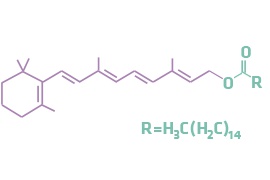
It's an ester form of vitamin A (retinol + palmitic acid) that belongs to the "retinoid family". The retinoid family is pretty much the royal family of skincare, with the king being the FDA-approved anti-aging ingredient tretinoin. Retinol is also a very famous member of the family, but it's like Prince George, two steps away from the throne. Retinyl palmitate will be then Prince Charlotte (George's little sister), quite far (3 steps) away from the throne.
By steps, we mean metabolic steps. Tretinoin, aka retinoic acid, is the active ingredient our skin cells can understand and retinyl palmitate (RP) has to be converted by our metabolic machinery to actually do something. The conversion is a 3 step one and looks like this:
retinyl palmitate --> retinol -- > retinaldehyde --> all-trans-retinoic acid
As we wrote in our lengthy retinol description the problem is that the conversion is not terribly effective. The evidence that RP is still an effective anti-aging ingredient is not very strong, in fact, it's weak. Dr. Leslie Baumann in her fantastic Cosmetic Dermatology book writes that RP is topically ineffective.
What's more, the anti-aging effectiveness is not the only questionable thing about RP. It also exibits questionable behaviour in the presence of UV light and was the center of a debate between the non-profit group, EWG (whose intentions are no doubt good, but its credibility is often questioned by scientists) and a group of scientists and dermatologists lead by Steven Q. Wang, MD, director of dermatologic surgery at Memorial-Sloan Kettering Cancer Centre.
Dr. Leslie Baumann wrote a great review of the debate and summarized the research available about retinyl palmitate here. It seems that there is a study showing RP being photo protective against UVB rays but there is also a study showing RP causing DNA damage and cytotoxicity in association with UVA.
We think that the truth lies somewhere in the middle, and we agree with Dr. Baumann's conclusion: "sufficient evidence to establish a causal link between RP and skin cancer has not been produced. Nor, I’m afraid, are there any good reasons to recommend the use of RP". We would add especially during the day!
Bottom line: If you wanna get serious about retinoids, RP is not your ingredient (retinol or tretinoin is!). However, if you use a product that you like and it also contains RP, there is no reason to throw it away. If possible use it at night, just to be on the safe side.
Domande frequenti su Retinyl Palmitate
Che cosa è retinyl palmitate?
Cosa fa retinyl palmitate per la pelle?
In che modo retinil palmitato è diverso dal retinolo?
Retinyl palmitate è sicuro da usare nella cura della pelle?
Come dovrebbero essere usati i prodotti retinil palmitato?
Prove e ricerca su Retinyl Palmitate
-
1
The Journal of investigative dermatology, 2003 Nov;121(5):1163-7., Vitamin A exerts a photoprotective action in skin by absorbing ultraviolet B radiationTrova in PubMed
-
2
Toxicology and industrial health, 2005 Sep;21(7-8):167-75., Photo-induced DNA damage and photocytotoxicity of retinyl palmitate and its photodecomposition products
-
3
Leslie Baumann, MD, Cosmetic Dermatology, 2nd edition, Retinoids, Chapter 30 - pages 256-262
Prodotti con Retinyl Palmitate (5 570 totale)
Più comune nei prodotti Boots (73 articoli)


